

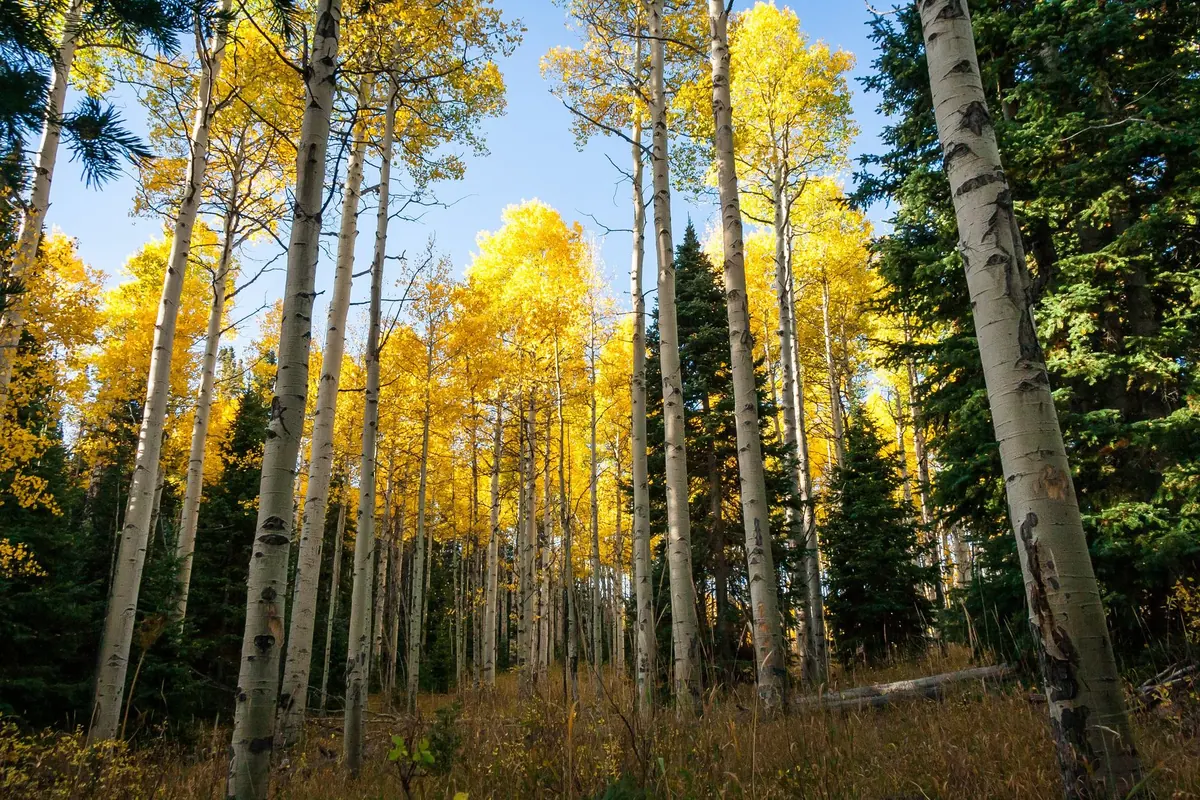
Aspen is the tree you hear before you see it. A breath of wind sets those flattened leaf stalks working, and the whole crown shimmers with a dry, papery rustle. Add butter-yellow autumn colour and genuinely fast growth, and it is easy to see why gardeners with a modest plot are tempted by Populus tremula.
The catch is the suckering. Aspen spreads by sending up new shoots from shallow lateral roots, often several metres from the trunk, and in a small garden those shoots appear in lawns, borders and gravel with equal enthusiasm. None of that makes aspen unusable. It simply means choosing a form and a position where you can manage it, rather than hoping it will behave.
Why aspen suits a small garden in the first place
Aspen is native, fully hardy and quick off the mark. Young trees put on height fast, which matters when you want screening in a few seasons rather than a decade. The foliage is light and constantly moving, so the tree filters sun and casts dappled shade instead of the heavy gloom a dense canopy would give. Spring catkins arrive early, the leaves feed a range of insects, and autumn brings a clean, even gold.
Two traits need respecting. Aspen wood is light and brittle, so mature trees can shed branches in strong wind; keep them away from play areas and parked cars, and prune to keep the crown open. And an unmanaged aspen will eventually reach 15 metres or more. In a small plot that usually means you either have room for a proper tree, or you plan to keep it smaller on purpose.
Choose the form before you choose the spot
Single-stem tree
The classic shape, and the one that needs the most room. Best in a lawn with space around it, set well back from buildings and boundaries. Eventually it will dominate whatever border it stands in.
Multi-stem
Two to five stems rising from ground level. You can buy a multi-stem bare-root plant in winter, or make your own: cut a young tree to near ground level in late winter, then keep the three to five strongest new shoots and rub out the rest. Narrower and more architectural than a single trunk, and it tucks neatly into a corner planting.
Stooled
Cut the whole plant back to a low stump every one to three years. Leaves get larger, the stems stay juvenile, and the plant settles at roughly two to three metres — a foliage feature rather than a tree. Hard cutting tends to wake up the root system, though, so stooling only makes sense where you can mow or pave around the base.
Managing suckers without declaring war
Two approaches work, and they are much more effective together than apart: repeated mowing, and physical containment. Mulch will not stop suckers — they push straight through 10cm of bark — and digging them out makes things worse by slicing the roots that produce them.
- Decide where suckers are allowed to appear. A lawn, a mown path or a rough grass strip cut fortnightly gives shoots somewhere to emerge where you can deal with them easily.
- Mow or strim every two to three weeks through the growing season. Cut at ground level. Regular cutting exhausts the shoot without stimulating more.
- Never dig them out, and don't rotovate near the tree. Disturbing the root encourages a fresh crop.
- Avoid systemic herbicide on suckers of a tree you intend to keep. It can travel back to the parent. Removing the tree entirely is a different job.
- Fit a root barrier if you need tighter control. A 60cm-deep vertical HDPE sheet with a lip above soil level helps, especially on heavier soils. On light sand, expect roots to slip underneath it.
- Use a container where space is truly tight. A pot 70cm across or more, standing on a hard surface, gives you a manageable specimen. Check the drainage holes each spring for roots trying to escape.
- Keep three to four metres between the trunk and your house, drains, boundary and any neighbouring paving.
One social point worth making early: suckers will reach a neighbour's garden if the roots run that way. Mention it before you plant, not after.
Four designs that work in tight plots
A multi-stem in mown grass
The simplest approach, and the one with fewest headaches. Set the tree in lawn, mow close around it, and let suckers join the grass. Underplant with spring bulbs, leaving a generous circle uncut until the foliage yellows in June. You get a specimen tree and a sucker control system in one.
A screening strip with mown edges
Plant three stooled aspens in a line, about 1.5 metres apart, and keep a 60cm mown strip along both sides. Growth is fast and dense in summer, and cutting the stems back to around 45cm in late winter keeps the screen low and thick. Because aspen is deciduous, pair it with evergreen structure — yew, holly, or a fence carrying climbers — so you are not left with bare stems from November to April.
A patio specimen in a large container
Confined roots mean almost no suckering. Use a loam-based compost, top-dress each spring, water properly for the first two summers, and underplant with bulbs and small ferns. The rustle of the leaves is a genuine asset next to a seating area; the aphids that often follow are not, so keep the pot a little away from the table.
A coppiced stool in a border
Give it a paved or mown apron of at least 1.2 metres all round, and the stool becomes a bold foliage plant with oversized leaves that set off dark evergreens and ornamental grasses. Cut back to 30–45cm in late February, just before bud burst.
Planting, pruning and aftercare
Bare-root plants go in from November to March, while the tree is dormant. Dig a hole twice the width of the rootball but no deeper, tease out the roots, backfill, firm gently, then mulch 5cm deep and keep the mulch clear of the stem. Water well through the first two summers. Stake only on exposed, windy sites — aspen usually establishes without help.
Prune in late summer to early autumn, when sap flow is lower and cuts seal before winter. Take out dead, crossing and low branches, and remove anything heavy that hangs over a path or driveway. Stooling is done in late February or early March. Before felling or carrying out major pruning, check whether the tree is covered by a Tree Preservation Order or sits in a conservation area; your local planning authority can confirm this, and it is worth a phone call rather than a fine.
Before you dig: the honest limitations
Aspen is deciduous, so it screens for roughly six months, not twelve. It drops leaves and catkins, which find gutters and ponds
Photo: Chris Loidolt / Pexels