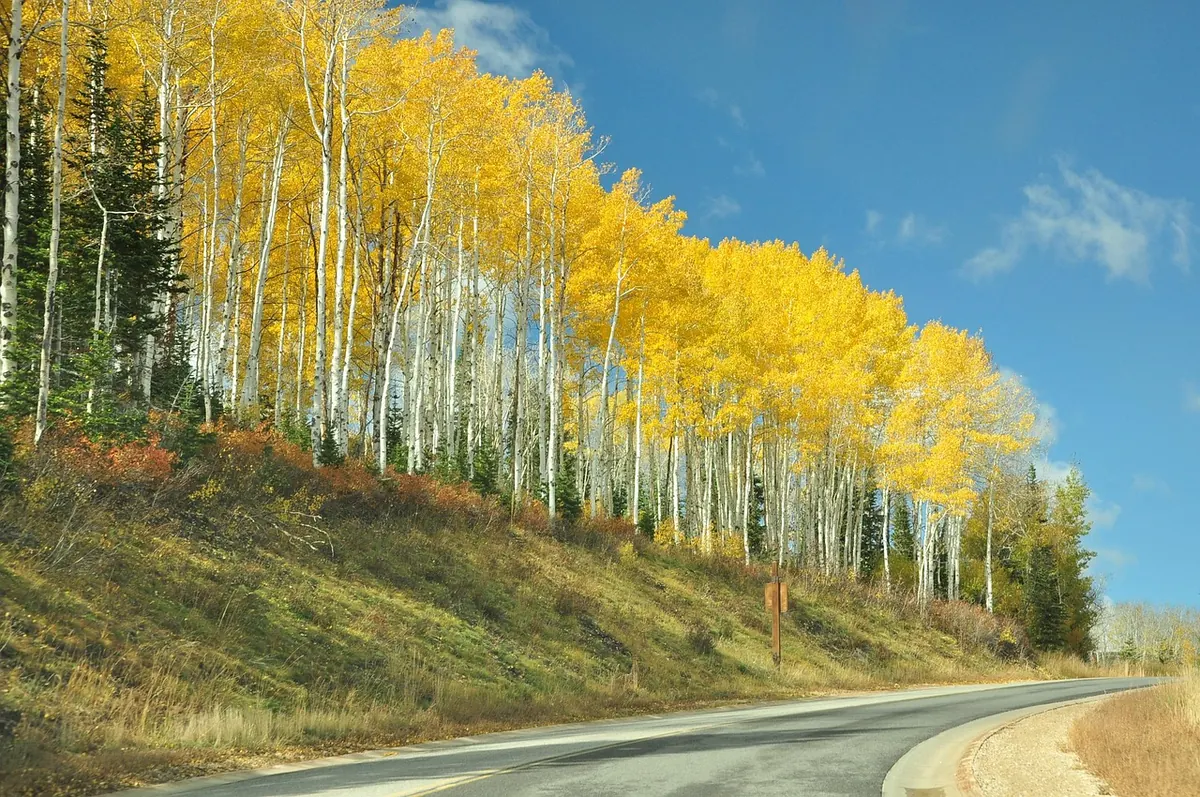

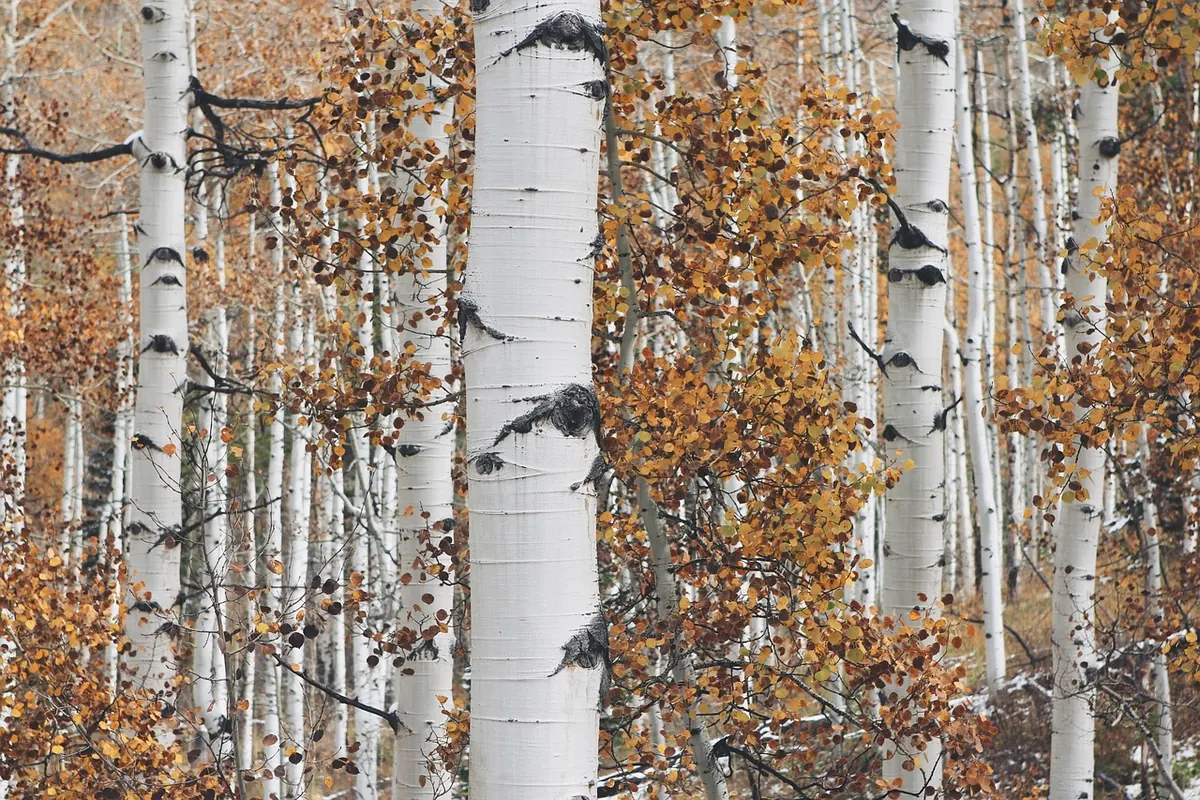
Few small trees earn their place in a British autumn like the aspen. The leaves turn a clear, bright gold, they tremble in the faintest breeze — the reason it is also called the quaking or trembling aspen — and within a few weeks the whole canopy is on the ground. Knowing why that colour appears, when leaf fall happens here, and what the tree needs as it shuts down for winter makes autumn care far more straightforward.
Why aspen leaves turn gold
Through summer, aspen leaves are full of chlorophyll, the green pigment that drives photosynthesis and masks everything underneath. The yellow pigments — carotenes and xanthophylls — are already present; they are simply hidden. As day length shortens and nights cool, the tree stops replacing chlorophyll, the green fades, and the gold that was there all along becomes visible.
Aspens are not generous producers of anthocyanin, the pigment behind the scarlets and purples of maples and cherries. That is why the display is almost always yellow-gold rather than crimson, though you will occasionally spot a tree with a coppery or orange flush. That is usually down to genetics, or to a spell of bright, mild weather late in the season.
What makes a good year for colour
Sunny days and cool — but not freezing — nights give the best show, because they let sugars and pigments develop in the leaf while slowing the breakdown of tissue. A hard early frost can brown the leaves before they ever reach full gold, and a very dry summer often brings a shorter, duller season. Trees in full sun colour up far more strongly than those in shade.
When aspen leaves turn and fall in the UK
Timing shifts with latitude, altitude and the weather, but the pattern is fairly consistent:
- Northern Scotland and upland Wales and northern England: colour from late September, peak in early to mid-October.
- Lowland Scotland and central and northern England: peak roughly mid to late October.
- Southern England, Wales, Ireland and sheltered coastal sites: peak late October into early November.
Leaf fall follows the colour by two or three weeks. Most aspens in the UK are bare by mid-November, although a mild, sheltered coastal tree can hold a few leaves into early December.
Why do they drop at all? A band of cells called the abscission layer forms at the base of each leaf stalk. Enzymes weaken the join, the tree withdraws what nutrients it can from the leaf before it goes, and a corky seal forms across the scar. Day length is the main trigger; temperature fine-tunes the timing. Once that layer is complete, one windy, wet spell will strip a tree in a couple of days.
Autumn is the best time to plant
Bare-root aspens go in between November and March while they are dormant, and an autumn planting gives the roots a head start before spring. Container-grown trees can be planted at most times of year, but autumn is still the kindest window: the soil is warm, rain is usually reliable, and the tree is not trying to push out leaves at the same time.
Aspens sucker freely from their roots and will form a thicket if you let them. That is part of their charm in a wild corner or a shelterbelt, and a nuisance beside a lawn, patio or drain. Give them room, and plant where you can mow around them.
- Stand bare-root trees in a bucket of water for an hour or so before planting if the roots look dry.
- Dig a hole wider than the root spread but no deeper than the roots need, and fork the base to loosen it.
- Plant at the same depth the tree was growing at the nursery — look for the soil mark on the stem.
- Backfill in layers, firming gently with your heel, then water thoroughly to settle the soil.
- Stake only if the site is exposed. Use a short stake and a soft tie that still allows the trunk to move.
- Mulch 5–8 cm deep over the root area, keeping it well clear of the trunk.
Seasonal maintenance for established trees
Rake leaves off lawns and paths. Healthy aspen leaves break down quickly on a compost heap and make decent leafmould; if the tree had rust or leaf spot, clear them and bin them instead. A thick mat left on grass will smother it over winter and give slugs somewhere to hide.
Prune with care. Poplars and aspens bleed sap heavily from cuts made between late winter and early summer, and open wounds at that time are more likely to be colonised. If work is needed, late summer to early autumn is the safer window — while leaves are still on, so you can see the structure of the tree. Restrict yourself to dead, damaged or crossing branches, and bring in a qualified arboriculturist for anything larger than you can reach comfortably from the ground.
Water young trees. A newly planted aspen needs watering through its first two or three summers, and a dry autumn spell matters just as much as a dry July. A slow soak once a week beats a daily sprinkle.
Keep suckers in check. Regular mowing is the simplest control; where that is not possible, cut them back with loppers or a brushcutter. Digging them out rarely helps, since severing a root tends to stimulate more growth.
Check stakes, ties and guards. Loosen ties before they bite into the trunk, and replace any guard that has cracked or split.
Pests and diseases to watch in autumn
Most aspens in the UK are trouble-free, but a few things are worth a look as the season turns:
- Rust shows as yellow-orange spots and pustules on the leaf surface in late summer and autumn. It is usually cosmetic; clearing fallen leaves reduces the spore load for next year.
- Leaf spot fungi cause dark blotches and early leaf loss. Same answer: tidy up the leaves.
- Aphids and leaf beetles can build up in a warm autumn, leaving sticky honeydew that turns sooty on anything underneath.
- Squirrels and deer strip bark from young stems. A spiral guard or a stout cage around the base prevents most damage.
- Anything unusual, or any damage to a tree near a boundary, road or building, is worth a call to a qualified arboriculturist rather than guesswork.
A short autumn checklist
Work through this in an afternoon and the tree goes into winter in good shape:
- Rake and clear fallen leaves — compost healthy ones, bin diseased ones.
- Water young trees if the ground is dry more than a few centimetres down.
- Cut back suckers in borders, gravel or paving.
- Loosen tree ties and check guards.
- Mulch after leaf fall
Photo: johnpriceonline / Pixabay