
Aspen gives itself away by moving. Stand at the edge of a Highland birchwood on a still September afternoon and you may hear it before you see it: a dry, papery shivering in one crown while every tree around it stands motionless. That is Populus tremula, the only aspen native to Britain. Learn three or four of its signatures and you will rarely mistake it again.
The confusion is fair enough. Aspen shares rough ground, damp heaths, moorland edges and open woodland with birch, and it belongs to the same genus as the poplars planted in parks, shelterbelts and roadside verges. It is, in effect, a small poplar that has spent a long time fitting into British landscapes. Once you know what to look for, though, it separates cleanly from both.
The leaves do most of the work
An aspen leaf is close to a circle: a green coin of three to eight centimetres across, with a short drawn-out tip and a margin that is wavy and bluntly toothed rather than sharply saw-edged. Hold one up to the light and the blade is thin, with a paler, grey-green underside and an even fan of veins running from the midrib out to the teeth. Birch leaves are smaller, more triangular, with a long point and a double row of fine sharp teeth — run a thumb along the edge and it feels like a comb.
The clincher is the stalk. On aspen it is unusually long, often as long as the blade itself, and flattened sideways like a ribbon rather than rounded, meeting the blade at right angles. The leaf is therefore a sail mounted on a flexible hinge, free to twist. The faintest air movement sets it spinning, and the whole crown shivers while the birch beside it hangs still. Pinch a leaf stalk between finger and thumb and you can feel the flatness; it is the single most reliable test in the field.
Two cautions. Newly opened leaves and the leaves of young suckers are often coppery, softly hairy, more triangular and far less obviously round, which has caught out many a confident identifier. And on a windy day every tree moves, so save your judgement for a calm one.
Why does aspen tremble?
The flattened petiole is the mechanical answer: it twists under the lightest pressure, presenting the blade edge-on to the wind, so the leaf spills gust instead of resisting it and the crown keeps its shimmer without tearing. The same arrangement lets each leaf track the sun through the day and shed heat on still, bright afternoons.
The quivering has also given aspen a folklore. In various traditions the tree was said to shudder in shame because its wood was used for the cross, or because Judas hanged himself from its branch. Whatever the story, the practical result is convenient: if one crown in a wood is moving and the rest are not, go and look at it.
Bark and buds: identifying aspen in winter
Stripped of leaves, aspen is still recognisable — and winter is when most people actually need the help. Young and middle-aged stems are smooth, pale grey-green to creamy grey, sometimes almost white under a bloom of algae; older trunks darken and coarsen into knobbly, furrowed, often blackened bark. The detail to look for is the horizontal, dark, diamond- or eye-shaped lenticels punctuating the smooth bark, along with the swollen scars left by fallen branches. Birch bark, in contrast, peels off in thin papery strips and carries neater horizontal bands; aspen bark roughens and flakes, but it rarely curls away in sheets.
Then check the buds. Aspen buds are large for the slenderness of the twig, pointed and ovoid, glossy red-brown to purplish, sticky with resin and strongly scented — rub one and you get the balsam smell of a poplar. Few native trees offer such a big scented bud on such a slim twig. Birch buds are small, pointed and green, and quite without scent, and the twigs they sit on are fine and often zig-zag.
Catkins, and the brief aspen snow
Aspen is dioecious: each tree is male or female, and only one sex grows on a given clone. Grey-green, woolly catkins open before the leaves, from mid-March into April, dangling like small lambs' tails. Male catkins show crimson anthers as they ripen; female catkins are longer and greenish, and after wind pollination they swell into strings of small capsules. By late May or June those capsules split and release tiny seeds wrapped in white down, drifting along tracks and over lochs in what looks briefly like a summer snowfall. The seed is short-lived and needs bare, damp, disturbed ground, so it rarely establishes in a crowded wood — one reason most British aspen spreads not by seed but by suckering.
One tree, many trunks
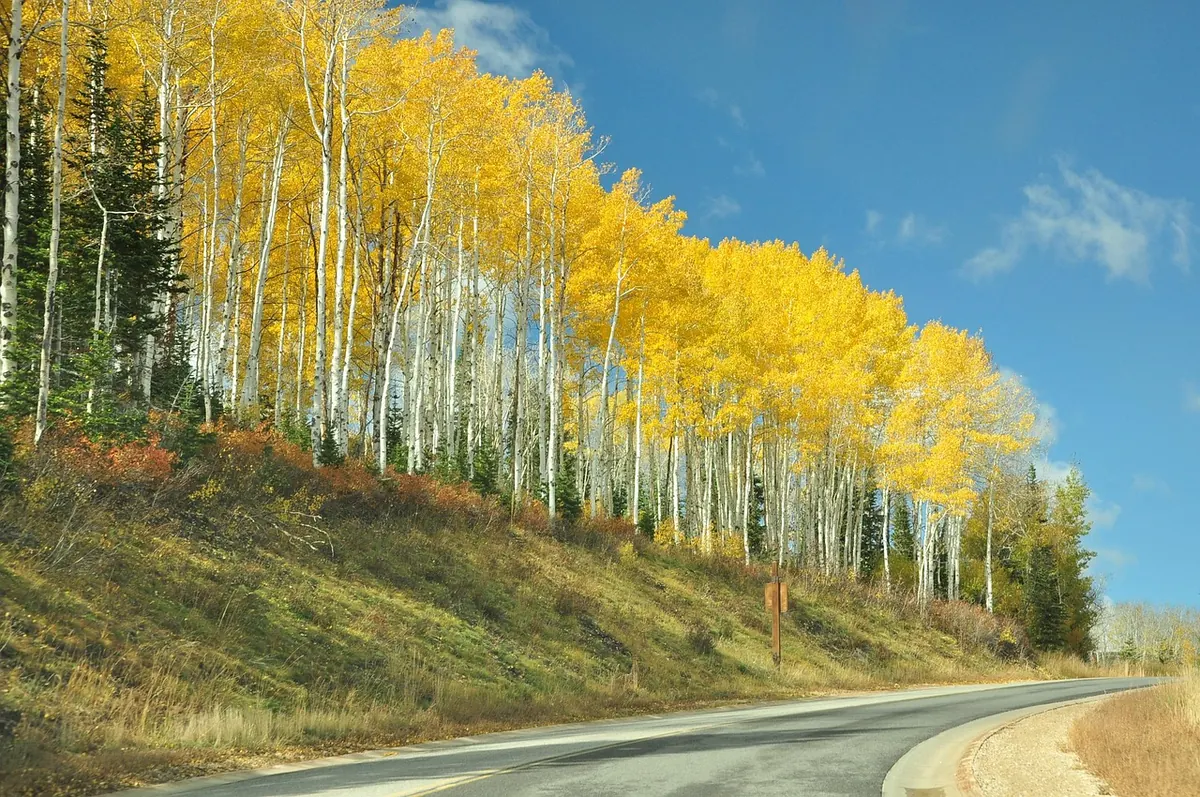
The most useful signature of aspen is often on the ground rather than on the tree. Aspen sends up suckers from shallow lateral roots, so a group of slender grey trunks in a rough field may be a single organism. The clues are uniformity and timing: every trunk in a colony carries the same leaf shape, the same bark colour and the same sex, and all of them come into leaf, turn gold and fall bare within days of each other — long after a mixed birchwood has begun to drift through autumn.
If a stand of aspens is all in step and none of it is flowering, you are probably looking at a clone. Some of these clones are thought to be extremely old, persisting for centuries or longer by repeatedly replacing trunks from the root. That makes British aspen a tree of wood edges and disturbed ground — and a fragile one: heavy deer and sheep grazing strips out new suckers, leaving ancient clones with no young trees to replace them. Much of the recent conservation work for aspen, in the Cairngorms and elsewhere, is simply about giving those suckers light and protection long enough to grow.
Aspen, birch and poplar: a quick comparison
- Aspen (Populus tremula) — round, blunt-toothed leaves on long flat stalks, fluttering in the faintest breeze; smooth pale grey-green bark with diamond-shaped lenticels; large, sticky, resin-scented winter buds
Photo: dalimiro / Pixabay